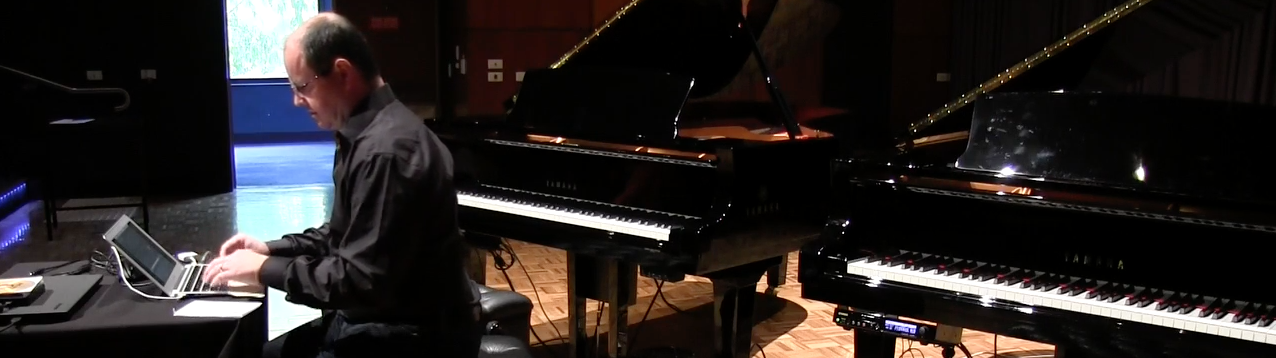
Beat Machine family of instruments is a collaborative project of John Ferguson and Andrew Brown.
The Beat Machine S3 was developed in 2025. It is a bespoke, handmade musical instrument designed and built from affordable electronic components, including an ESP32-S3 microcontroller, CD4051 multiplex chips, GY512 accelerometer, and a PCM5102 digital-to-analogue converter. The wooden version has an elegant, laser-cut wooden enclosure using a living hinge design with panel-mounted interface controls. It incorporates a LiPo battery and charging circuitry, plus a small amplifier and speaker to support portable performance. Details of a live duet performance with the BM Wooden are here.
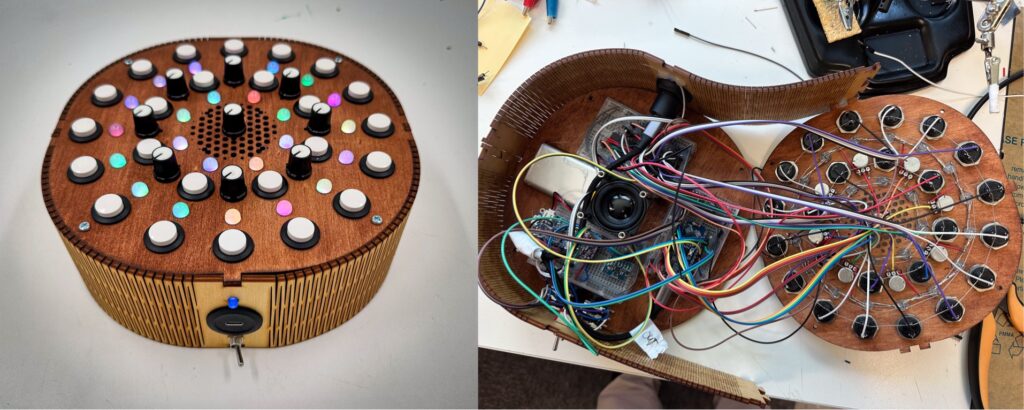
The BM S3 and BM Wooden offer a range of rhythm generation algorithms, including Euclidean, polymetric, geometric, and probabilistic approaches enabling both organised and chaotic rhythmic organisation. Each Beat Machine can play up to eight parts, with each part independently generated and algorithmically modulated. Parts may vary in length and tempo. All sounds are produced using a shared synthesis architecture that combines established subtractive and frequency modulation techniques that lean into a lo-fi aesthetic. Generated patterns and timbres can be triggered at will and edited manually during performance.
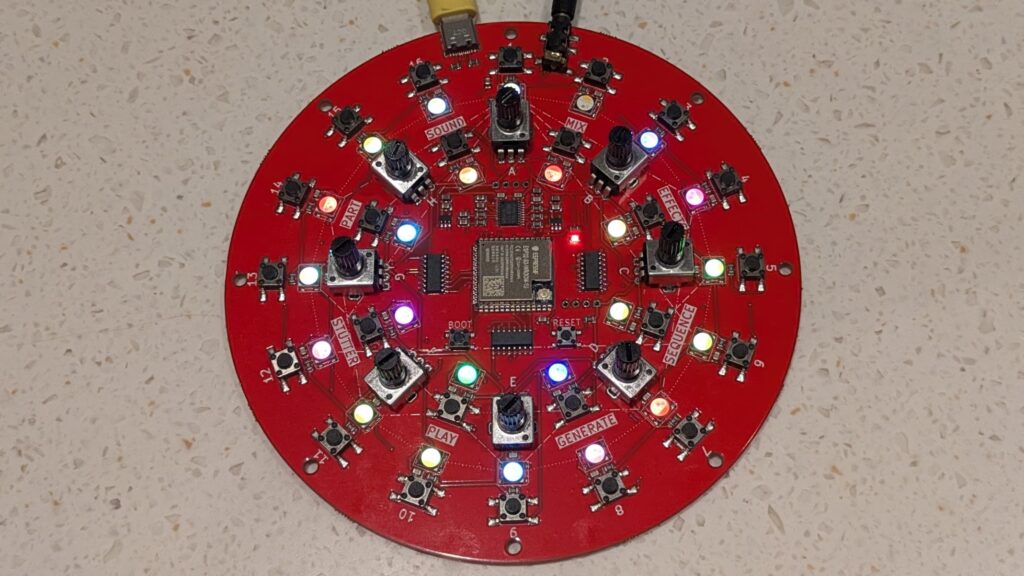
The instrument’s interface features a compact, circular arrangement of buttons, lights, and dials, visually reinforcing the cyclical nature of the looping sequences that underpin the machine’s beats. Circular interfaces have long been popular for rhythm machines, with examples including the Buchla 252e, ndial, Pattening, and Orbita. The interface has been refined through iterative experimentation to provide performers with access to the instrument’s full range of features, while LED colour and animation provide clear, real time feedback.
A more compact, machine-assembled/printed-circuit-board version of the Beat Machine S3 has also been developed for wider distribution and more obviously invokes the previous Beat Machine design.
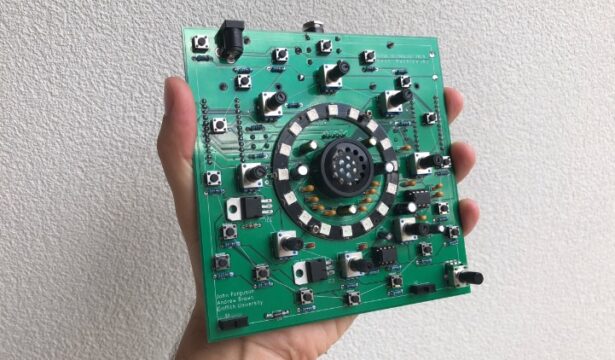
The first Beat Machine was a 16 step sequencer and 3 voice percussion synthesizer controlled by 10 potentiometers, 19 buttons, and an accelerometer. The original Beat Machine was developed from 2019 to 2021 and used to teach a course in electronic instruments at Queensland Conservatorium Griffith University, the video below is student work from the class of 2021.
The controls are connected to two Arduino Pro Micro microcontrollers that communicate via the I2C communications protocol, one microcontroller handles the sequencing and the other functions as a synthesizer using the Mozzi library. There are three layers of control, one for each voice. For an overview see Beat Machine v 0.3 Guide. Low-cost tactile switches are used to enter step-sequences and to access the various layers of control. A ring of programmable LEDs (light emitting diodes) indicates sequence pattern and layer information so the user can see where steps have been programmed to sound and which synthesizer voice these correspond to. The first voice is optimised for a bass drum-like tone (noise source has high frequency rolled off), the second voice is optimised for a high-hat like tone (noise source has low frequencies rolled off), the third voice is full-range and is intended to approximate a snare drum. Each synthesizer voice is made up of two oscillator elements that can be blended together or sounded in isolation using the balance control, the first is a sine waveshape and the second can either be a sawtooth waveshape or a noise source. When using sine and saw these can be detuned by up to an octave and then pitch-fall and the attack/release amplitude controls can be used to sculpt the overall sonic character of each voice. Pitch, volume, and distortion controls are also available.
Below is a video presentation for the UbiMus 2021 conference about the use of custom PCBs for bespoke electronic music instrument designs, like the Beat Machine.
See also:
- Andrew R. Brown, John R. Ferguson; Beat Machine: Embracing the Creative Limitations and Opportunities of Low-Cost Computers. Leonardo Music Journal 2020; 30 8–13. doi: https://doi.org/10.1162/lmj_a_01087
- Andrew R. Brown, John R. Ferguson; 2021. Enhancing DIY musical instruments with custom circuit boards. Proceedings of the 11th Workshop on Ubiquitous Music
- For a more informal discussion see ‘Professor Andrew Brown and Dr John Ferguson discuss DIY Electronics and Post-digital Practice in the context of their “Beat Machine” project’: https://www.youtube.com/watch?v=X4lFmh8l_Gs