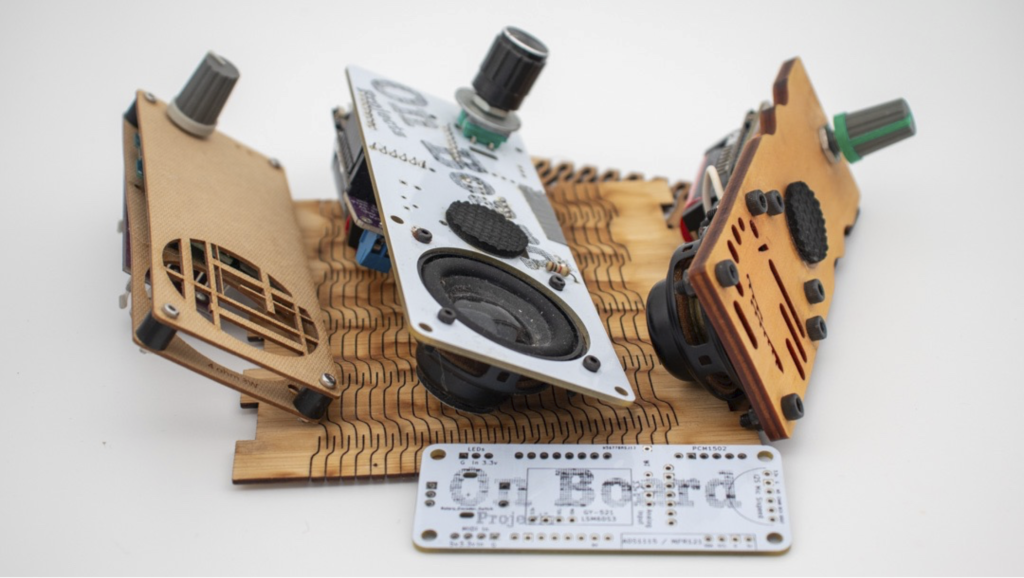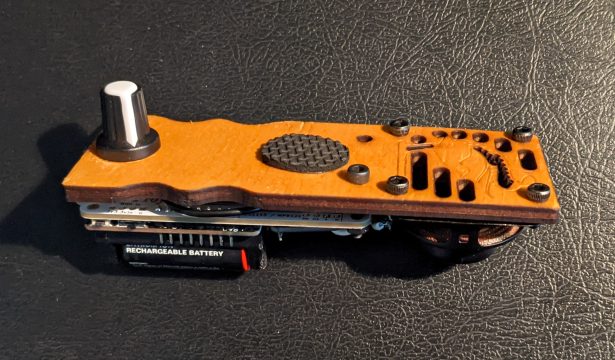
The On Board Call is a hand-held gesture-controlled device that performs synthesised imitations of wildlife calls. These include the sounds of birds, frogs, fish, and the like. Wildlife calls are diverse and often complex; the Call focuses on short-pitched sounds and so is better for bird calls than, say, a lion roaring. The device uses the On Board PCB v2 with an ESP8266 microprocessor, an accelerometer for parameter control, a force-sensitive resistor for amplitude, a rotary encoder for adjusting settings, and an amp board and built-in loudspeaker for sounding. The software uses the Mozzi audio library and an evolving set of algorithms derived from analysing spectral analysis of wildlife sounds. The Call is designed for portable handheld use, so it can be taken in the field to various ecological environments for close listening and imitation or used as an instrument for performance.
The devices were designed to encourage deep listening through imitation. Using the devices to copy wildlife sounds, especially bird calls, heard in natural settings. They are also simple, yet expressive musical instruments.
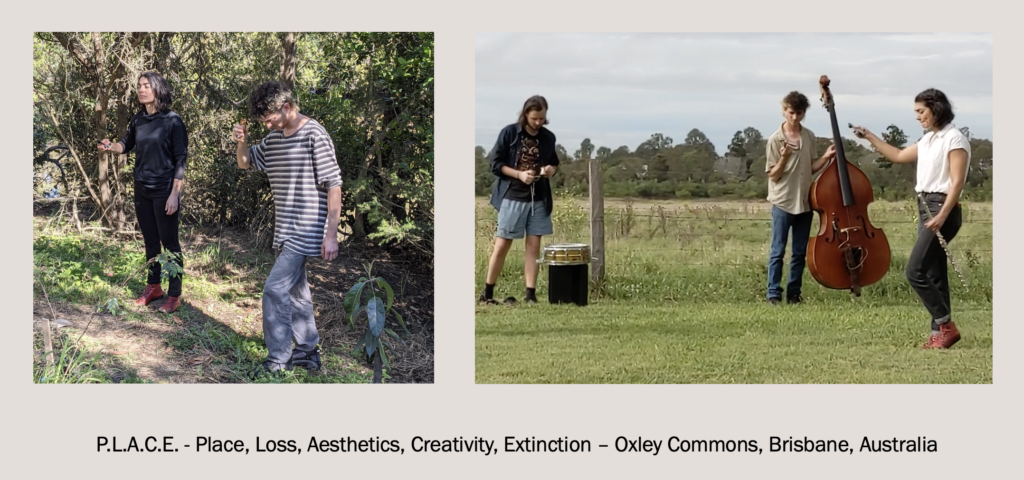
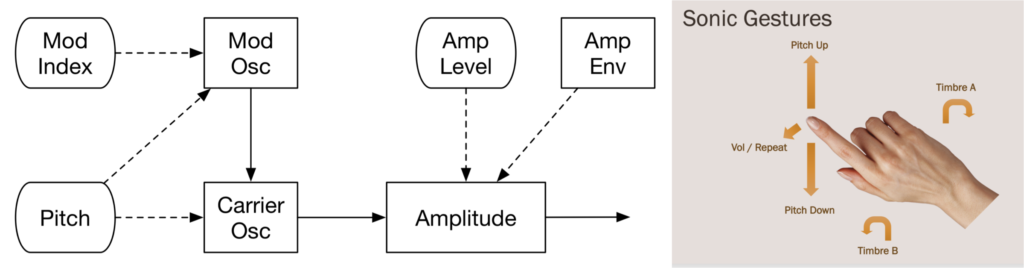
The Call uses a simple FM synthesis program running locally on the microprocessor. The synthesis architecture is shown below. The device includes a pressure sensor for loudness and introducing trigger repetitions, an accelerometer to detect movement gestures that are mapped onto modulation index and depth parameters (thus timbre) changes, and a dial that controls the volume.
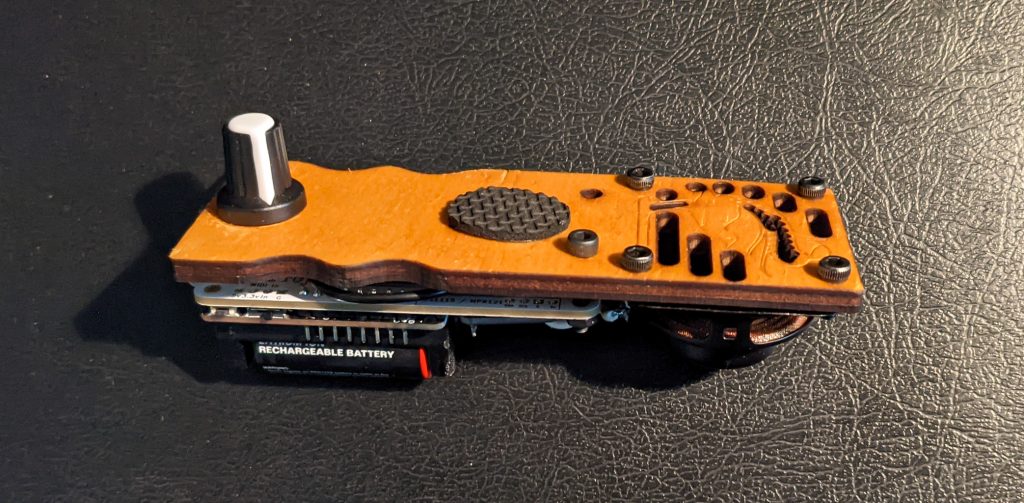
As with all designs, the OnBoard Call went through a series of iterations that explored and refined the functionality and aesthetics of the device. An enclosure was added at the request of organisations that facilitate access to wildlife spaces to improve the look and perceived safety of the devices for their clients.