
Modulation synthesis has been a foundational technique in the development of electronic musical instruments since their inception. Maxiumum Silence to Noise (MSN) is a novel approach to ring modulation synthesis, termed Maximum Silence to Noise (MSN), along with an associated method of gestural control facilitated by a pressure-sensitive multi- touch controller. The primary objective of developing this was to make an instrument capable of producing a broad and diverse range of audio spectra that can be expressively articulated through responsive touch- based interaction. Integrating the synthesis process with gestural parameter mapping is crucial for the performative capabilities of New Interfaces for Musical Expression (NIMEs). The technical development of an MSN-based instrument was subject to an iterative design process with mixed method evaluation. The usability and practical application of the MSN instrument was refined through performance experiences, which illustrate the effectiveness of the synthesis-gesture mappings in providing dynamic and expressive control over the diverse generated audio spectra.
DIY instruments using modulation synthesis are prized for their raw, dynamic sound and expressive touch interaction, keeping them popular. Influences behind the MSN instrument include the Crackle Box, BoardWeevil, and Atari Punk Console—each known for using ring modulation or related techniques to create dynamic, inharmonic spectra. A second major source of inspiration for the MSN instrument is the use of multi-touch interfaces for gestural expression. One of the attractions of the low-fidelity ‘noise’ machines is the immediacy of sound making through touch control. It was important to emulate this in the interface design for the MSN instrument. Simple, yet expressive, gestures have always been at the heart of musical expression.
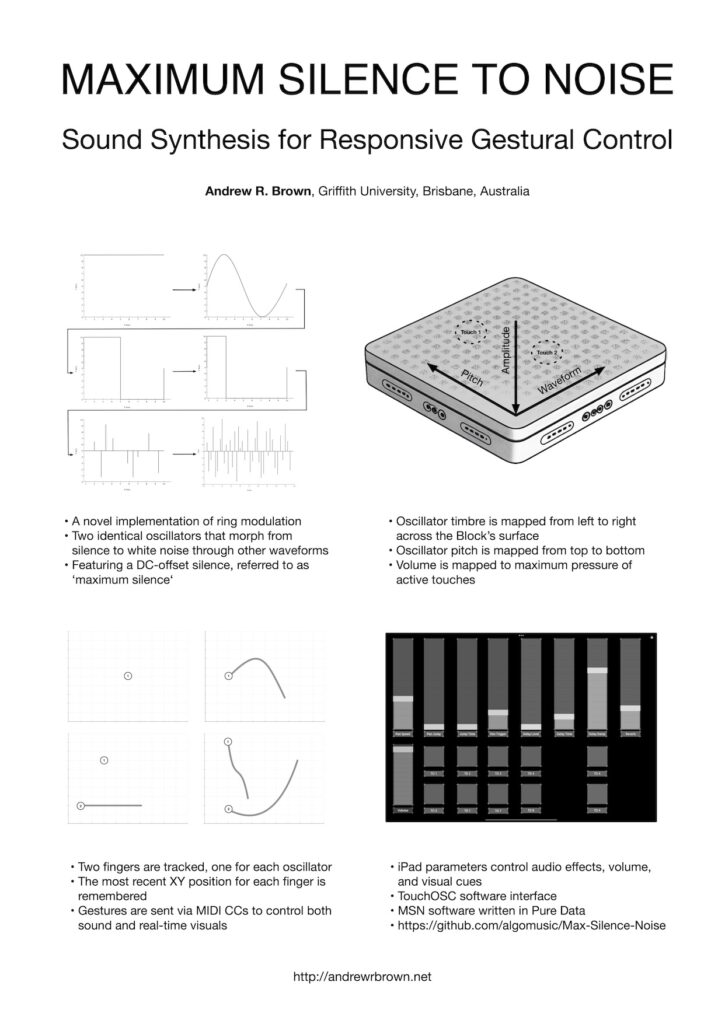
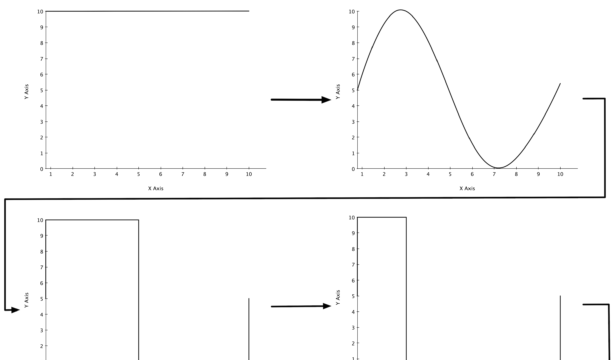
At the heart of the MSN instrument is a novel implementation of ring modulation that features two identical oscillators that morph from silence to white noise, passing through sine and square waveforms along the way. These morphing oscillators enable a smooth transition from simple to complex audio spectra. To achieve a staged and interesting transition from silence to white noise, the MSN oscillator morphs between several wave types as illustrated in Figure 1. The first is DC-offset silence, referred to here as maximum silence, and the second is a sine function. The pure sine wave transitions to a more hollow-sounding square wave, then the pulse width of the square is adjusted for a more nasal timbre. From here the sound cross fades to noise waveforms, featuring a mixture of random cracking that produces a fire-like timbre and concluding with white noise. In the MSN instrument, two of these morphing oscillators are ring modulated.
MSN is implemented in Pure Data, the implementation is available online. The MSN instrument hardware integrates with the Pure Data (Pd) software, incorporating a ROLI Lightpad Block and an iPad running TouchOSC. The Pd patch receives MIDI data from the block via USB. In many performances with the MSN instrument, interaction data from the instrument is also transmitted to a Touch Designer network, which generates visual materials.
Duet performances with the MSN instrument of the composition MSN-AV have been presented by myself and John Ferguson.
An academic article about MSN was published at the New Interfaces for Music Expression (NIME) conference in 2025. Brown, A. R. 2025. “Maximum Silence to Noise: Sound Synthesis for Responsive Gestural Control.” In Proceedings of the New Interfaces for Music Expression Conference. Canberra, Australia: NIME.